
Char Dham Winter Seats: Where to See Kedarnath, Badrinath, Gangotri and Yamunotri in Winter
Also called Shitkalin gaddi sthal · चारधाम शीतकालीन गद्दी स्थल
In winter the Char Dham deities are worshipped lower in the valleys: Kedarnath at Omkareshwar Temple in Ukhimath, Badrinath at Pandukeshwar and Jyotirmath, Gangotri at Mukhba near Harsil, and Yamunotri at Kharsali near Janki Chatti. All four are open through winter for darshan.
| Kedarnath | Omkareshwar Temple, Ukhimath |
|---|---|
| Badrinath | Pandukeshwar (Yogdhyan Badri) and Narsingh Temple, Jyotirmath |
| Gangotri | Mukhba village, near Harsil |
| Yamunotri | Kharsali village, near Janki Chatti |
| Open | All winter (Nov - Apr/May) |
| Trip length | About 6-8 days for all four |
The high shrines of the Char Dham shut their doors each November, but the worship never stops. In a slow, joyful procession, each deity is carried down in a decorated doli to a winter home lower in the valley, where daily puja continues until the doors reopen in spring. These four villages and towns are the winter seats (shitkalin gaddi sthal) of the Char Dham.
They are open all winter, much easier to reach than the shrines above, and far quieter. For many pilgrims, a winter yatra to them has become a pilgrimage in its own right.
Where do the Char Dham deities go in winter?
Kedarnath goes to Ukhimath, Badrinath to Pandukeshwar and Jyotirmath, Gangotri to Mukhba and Yamunotri to Kharsali.
- Kedarnath: Omkareshwar Temple, Ukhimath (Rudraprayag district)
- Badrinath: Yogdhyan Badri at Pandukeshwar (Uddhav and Kuber) and the Narsingh Temple at Jyotirmath (the seat of Adi Shankaracharya) (Chamoli district)
- Gangotri: Mukhba village, near Harsil (Uttarkashi district)
- Yamunotri: Kharsali village, across the Yamuna from Janki Chatti (Uttarkashi district)
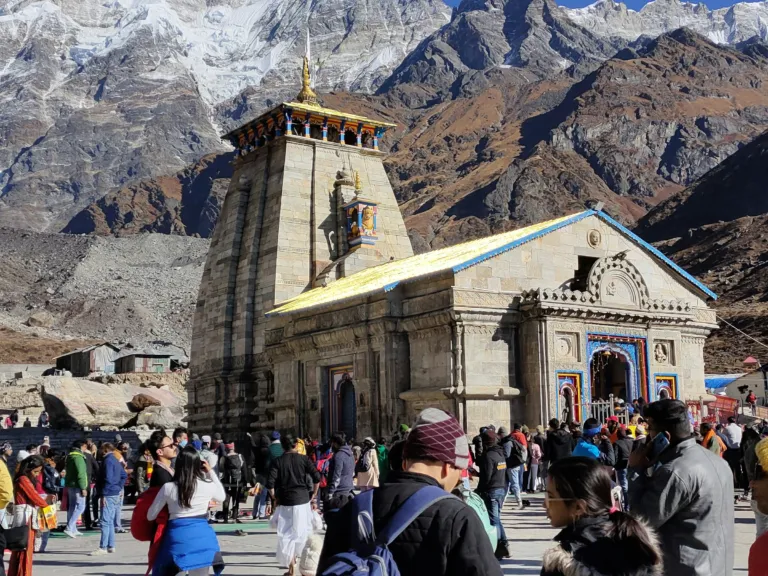
The shrines close in November 2026: Gangotri on 10 November, Kedarnath and Yamunotri on 11 November, and Badrinath on 16 November. See our Char Dham closing dates 2026 for times and rituals.
Omkareshwar Temple, Ukhimath (Kedarnath)
The winter home of Lord Kedarnath, and the place where his opening date is announced every year on Mahashivratri. The five-faced festival idol of Shiva arrives here in a doli procession a few days after Kedarnath closes, and stays until it is carried back up in late April or May.
- Where: Ukhimath town, on the hillside across the Mandakini from Guptkashi.
- Distance: about 41 km from Rudraprayag and roughly 180 km from Rishikesh by road.
- Also nearby: the road to Chopta and Tungnath starts from Ukhimath. Tungnath's own winter seat is at Makkumath.
Pandukeshwar and Jyotirmath (Badrinath)
Badrinath's winter worship is split between two places a short drive apart. At Pandukeshwar, the idols of Uddhav and Kuber are worshipped at the Yogdhyan Badri temple. At Jyotirmath, the gaddi of Adi Shankaracharya is kept at the Narsingh Temple, one of the most important shrines in the town.
- Where: Pandukeshwar is about 20 km from Jyotirmath towards Badrinath.
- Distance: Jyotirmath is about 255 km from Rishikesh.
- Also nearby: Auli's snow slopes are just 13 km above Jyotirmath; see our Auli skiing guide.
Mukhba (Gangotri)
The village of the Gangotri priests, where Mother Ganga spends the winter. Her doli reaches Mukhba the day after Gangotri closes, and daily aarti is held at the temple here through the winter. The village sits above the Bhagirathi, facing the snowy ridges near Harsil.
- Where: about 2 km from Harsil, on the Gangotri road.
- Distance: roughly 75 km from Uttarkashi and about 230 km from Dehradun.
- Good to know: the road beyond Uttarkashi can be icy or briefly closed after snowfall; travel in daylight.
Kharsali (Yamunotri)
The home of the Yamunotri priests and the winter seat of Goddess Yamuna. Kharsali is a small stone-and-wood village across the river from Janki Chatti, with an old temple of Shani Dev, believed to be Yamuna's brother.
- Where: about 1 km from Janki Chatti, the start of the Yamunotri trek.
- Distance: roughly 45 km from Barkot and about 175 km from Dehradun.
How to plan a winter Char Dham yatra
You can visit all four winter seats in about 6-8 days from Dehradun or Rishikesh, by road.
- Route: Dehradun → Barkot → Kharsali → Uttarkashi → Mukhba → back via Tehri → Rudraprayag → Ukhimath → Jyotirmath and Pandukeshwar → Rishikesh.
- When: December to March. Expect cold nights, and keep a spare day in case snow closes a road.
- Darshan: daily puja and aarti continue at all four seats. Timings vary by temple and season; ask the temple office or your hotel.
- Stay: Ukhimath, Guptkashi, Jyotirmath, Uttarkashi, Harsil and Barkot have guesthouses and GMVN rest houses open in winter.
- Pack: heavy woollens, gloves, shoes with grip, and a torch for early mornings.
The shrines above reopen in late April or May 2027. Gangotri and Yamunotri usually open on Akshaya Tritiya, Kedarnath's date is announced at Ukhimath on Mahashivratri, and Badrinath's on Basant Panchami. Always check BKTC and temple committee notices before you travel.
 Read our guideAuli Travel Guide 2026: Snow, Skiing & Himalayan MeadowsOur full guideOpen guide ›
 Read our guideTungnath and Chandrashila 2026: Highest Shiva Temple, Trek from Chopta & How to ReachOur full guideOpen guide ›
Char Dham Winter Seats: Where to See Kedarnath, Badrinath, Gangotri and Yamunotri in Winter: FAQs
Where is Kedarnath worshipped in winter?
At the Omkareshwar Temple in Ukhimath, Rudraprayag district.
Where is Badrinath worshipped in winter?
At Pandukeshwar (Uddhav and Kuber, at Yogdhyan Badri) and at the Narsingh Temple in Jyotirmath, where Adi Shankaracharya's gaddi is kept.
Where does Gangotri go in winter?
To Mukhba village, about 2 km from Harsil.
Where is Yamunotri worshipped in winter?
At Kharsali village, across the river from Janki Chatti.
Can I do Char Dham yatra in winter?
Yes, to the four winter seats. They are open all winter and reachable by road; the high shrines themselves stay closed until April-May.
How many days does a winter Char Dham yatra take?
About 6 to 8 days from Dehradun or Rishikesh by road.
More stories
 Char Dham Closing Dates 2026: When Kedarnath, Badrinath, Gangotri and Yamunotri Close for WinterTemples & legends · 4 min read
 The Legend of Tapkeshwar: Drona, Ashwatthama and the Cave of Dripping MilkTemples & legends · 4 min read
 Ganga Aarti at Har Ki Pauri: The Story Behind Haridwar's Evening PrayerTemples & legends · 5 min read